
OpenGame guide
Destructible Environment Game Design: Loadpath Zero
See how Loadpath Zero uses five demolition contracts, visible structural cues, protected assets, target zones, and useful browser-game retries.
 OpenGame Team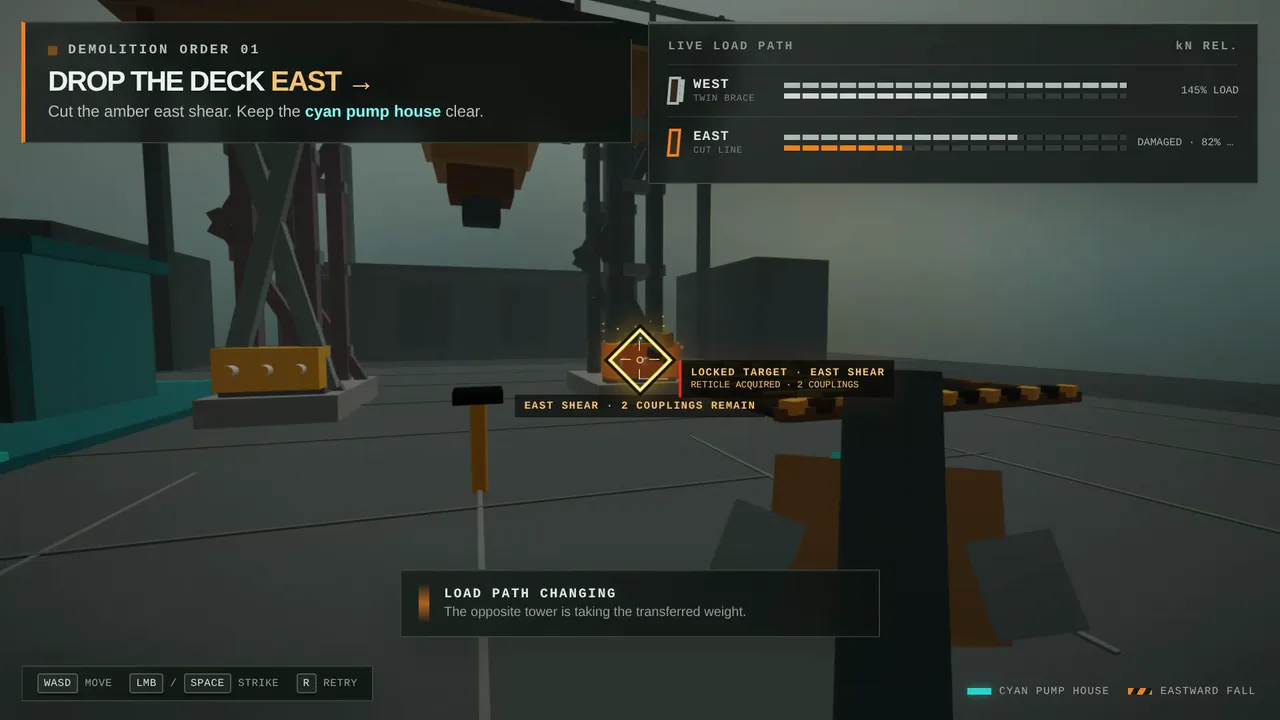
Destructible environment game design becomes interesting when a collapse is a decision rather than a button press. LOADPATH ZERO turns that idea into five distinct demolition contracts. The player reads a highlighted load path, chooses a consequential support, swings a Shear Maul, and moves before the falling structure reaches them.
The goal is not to destroy everything. Each contract asks the player to direct enough falling mass into a cyan target zone while preserving marked structures and staying outside the collapse path. That combination makes the game a useful reference for an AI game builder workflow: spectacle works best when the player can explain what they changed, why the structure moved, and why the attempt succeeded or failed.
Make the structural decision visible
A satisfying collapse needs spectacle, but a playable collapse also needs causality. LOADPATH ZERO exposes glowing structural veins, a gold strike outline, protected markers, target zones, and a written objective before the decisive movement begins.
Those signals let the player form a plan instead of interpreting a random result after the fact. The highlighted support answers “where can I act?” The cyan target answers “where should the mass go?” Protected structures answer “what must survive?” The first-person camera makes the remaining question physical: “where should I stand when this falls?”
The game does not need to reproduce real engineering materials to make that decision readable. It needs a consistent relationship between visible cues, the player's strike, the direction of motion, the protected space, and the final evaluation.
Use five contracts to vary one clear verb
All five contracts share a compact control language, but they can test different interpretations of the same core verb. One job may emphasize placing debris inside a target. Another may punish damage to a protected structure. A later job can make the safest approach angle or the direction of collapse more important.
This structure avoids two common problems. The game does not introduce a new control scheme every level, and it does not repeat one arena with only a different title. The player keeps the knowledge that matters—how to move, read a load path, strike, escape, and retry—while each contract changes the spatial problem.
An AI game generator can use the same pattern without copying this game. Choose one understandable action, then design several short scenarios that change the constraint around it. The result can feel broader without becoming harder to learn.
Make the tool feel consequential
The Shear Maul gives the player a direct, physical relationship with the structure. The player must move close enough to line up the strike, commit to the highlighted support, and then react to the resulting movement.
That sequence is stronger than triggering destruction from a remote menu because it connects risk and agency. The same first-person position used to inspect the structure can become dangerous once the mass begins to move. A correct structural decision can still produce a failed attempt if the player remains in the hazard zone.
The tool also keeps the interaction legible. The game does not ask the player to manage a construction interface, an inventory, and a physics editor at the same time. One tool, one marked intervention, and one visible consequence are enough to support a complete loop.
Treat safety and preservation as mechanics
LOADPATH ZERO can end an attempt for more than a missed target. Burial, damage to a protected structure, poor placement, or another failed objective all matter. This prevents “more debris” from becoming the only measure of success.
Protected markers and target zones make those constraints visible before the strike. The player can therefore take responsibility for the outcome. When an attempt fails, the reason belongs to the same visual language used to plan it.
This is useful beyond demolition games. A rescue game can ask the player to preserve civilians while opening a route. A logistics game can reward delivery without damaging cargo. A puzzle game can score the final state rather than the number of objects moved. The important design choice is to judge the consequence the player was able to anticipate.
Make retries useful, not punitive
A failed contract can be rebuilt immediately with R, while the contract menu lets the player return to an unlocked job. Fast retry matters because the game is about comparing decisions: approach from another side, strike a different support, leave the hazard area earlier, or create more room for the structure to rotate.
The public control set stays focused:
- Click Enter the Yard, choose an unlocked contract, and click the canvas if Pointer Lock is needed.
- Use
W,A,S, andDto move and the mouse to look. - Use the left mouse button to swing the Shear Maul.
- Hold
Shiftto sprint and pressSpaceto jump. - Press
Rto retry, and useEscorPto pause.
These controls support inspection, intervention, escape, and retry—the four actions required by the core loop. Extra inputs would need to justify themselves by making one of those actions clearer.
Design the page and the game as one experience
The public game page explains the goal, failure conditions, controls, device fit, and practical tips before the player enters the sandboxed browser frame. The game then repeats the essential objective through its own contract interface and visual markers.
That handoff matters. A browser game cannot assume the player has installed a manual or completed an onboarding sequence. The surrounding page should answer whether the game is desktop-first, how to take control, and what success means. The game itself should then confirm the immediate decision without forcing the player to remember a long article.
Use the result as evidence, not a clone target
Play LOADPATH ZERO to test the current five-contract release. Study how it connects structural cues, first-person position, a decisive strike, visible constraints, ordinary failure, and immediate retry.
The finished game is a hand-built flagship reference, not a one-click template. If the structure gives you an idea, use OpenGame Studio to define an original profession, environment, tool, hazard, target, progression, art direction, and failure state. Keep the useful relationship between action and consequence, then make a different game around it.
You can also browse the OpenGame games directory for complete playable loops or compare other curated work in the OpenGame Showcase.
Source note
This revision describes the current public LOADPATH ZERO page and its published five-contract gameplay information. It does not reuse an older three-contract prototype as evidence for the current release.