
Game guides
Cork7 Controls & Tricks: Your First Clean Landing
Learn Cork7 controls, jump timing, cork inputs and clean landings, then try a separate original ski challenge made in OpenGame Studio.
Official instructions checked October 26, 2026.
Cork7 is a free browser freeski game. Open the official game, choose Solo and use the park map to begin. A useful first goal is one controlled takeoff and landing. This guide offers a practice sequence and, below, our separate OpenGame skiing experiment.
Know which input changes in the air
The developer's controls guide documents these defaults:
| Input | On snow / in the air |
|---|---|
| A / D | Carve / spin |
| W | Pole or tuck / frontflip |
| S | Brake / backflip |
| Left / right arrows | Air roll |
| Space | Hold to load, release to pop |
| Shift / Q / E | Mute / tail / Japan grab |
| F | Skip the gondola |
| Hold R for two seconds | Restart from the top |
| Esc / P | Menu or pause |
Bindings can be changed in Settings → Controls. The developer also documents controllers and touch input, and recommends a desktop keyboard. Kickers can launch the skier without a manual jump; release a grab to open up before landing.
A first-session practice routine
Our suggested routine changes one decision at a time. It is a learning exercise, rather than a verified route through a particular park.
- Choose a repeatable approach. Find a visible jump and aim to approach it the same way on each attempt. It is hard to interpret a crash if you changed your speed, line and trick together.
- Watch a straight takeoff. Before adding rotation, notice where the skier leaves the snow, how much time the jump gives you, and where the landing lies. You want a visual reference you can recognize on the next attempt.
- Separate approach from trick. Decide which inputs you need before the lip and which you want after it. Releasing an approach input can be as deliberate as pressing a trick input.
- Add one rotation input. Make a small change, then leave yourself room to prepare for contact with the slope. If the result feels uncontrolled, reduce the combination before increasing it.
- Keep one observation. Write a short note such as “I was still rotating when I reached the snow” or “I started the flip after the spin.” A specific observation suggests a specific adjustment.
An early attempt can be useful even without a high score. The question is whether you can explain the result and repeat the part that worked. Once the approach and landing feel understandable, add another decision.
How to do a cork in Cork7
The official recipe is A or D with S at the lip; spin with W produces a bio. The guide places the combined spin-and-flip input within 0.25 seconds of takeoff. Adding spin later only tilts the flip. The displayed trick follows the movement completed, rather than just the buttons pressed.
Use that distinction when practicing. First identify the intended combination, then watch when you began it. If the result has a different name, compare the motion you saw with the inputs you intended. Repeating the same unclear combination is less informative than testing a simpler one and noticing the difference.
Make the next attempt easier to understand
Cork7's documented scoring rewards rotation, grabs and connected lines; crashes lose the current line, and repeated tricks lose value. For exact current multipliers, use the linked official guide.
For practice, choose one goal before starting: understand a takeoff, hold a simpler line, or prepare earlier for a landing. Judge that attempt against the chosen goal. A personal-best score is useful feedback, but it does not tell you which action improved.
Replays can help you inspect an attempt. Cork7's local-save explanation says replay saves stay in the browser on that device; signing in elsewhere does not transfer them. Export clips you want to keep before clearing browser data.
Our original skiing experiment: Snowline Sprint
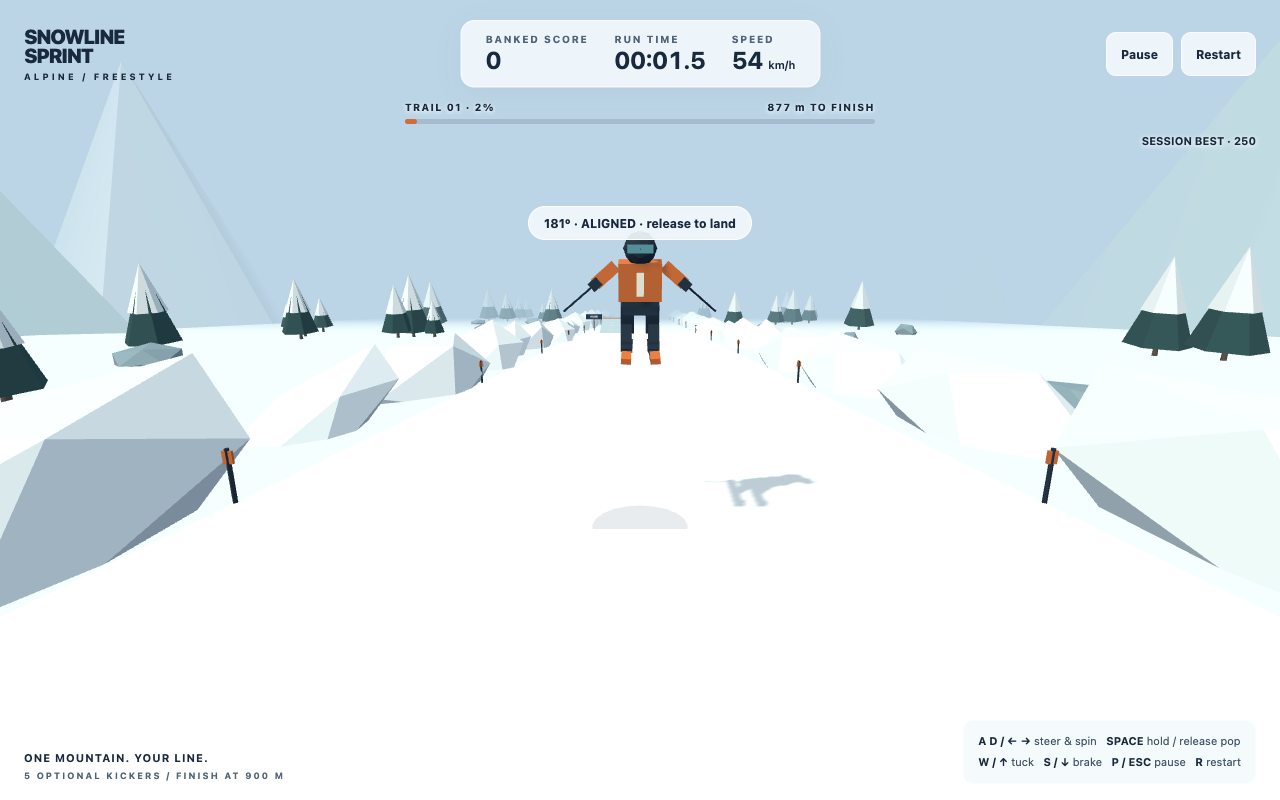
We used OpenGame Studio to make Snowline Sprint, a separate original low-poly 3D skiing prototype. It has one 900 m trail and five optional kickers. Staying on the clear central route is enough to finish; tricks improve your score rather than unlock the finish.
In the first generated version, actual website keyboard input completed the trail in 60 seconds, landed a 180 for 100 points and a 360 for 250, and exercised the sideways-landing and off-trail crash flows. A first kicker also launched the skier naturally and allowed a straight landing. Pause froze the observed run state, and restart returned the run to ready.
The phone-sized test found something the desktop run did not: at a safe position near the side of the trail, the skier could move outside the narrow camera view. We requested one focused Studio revision for lateral camera tracking, consistent final-time formatting and larger small-screen controls.
The revised version passed the same 900 m finish and landed-spin checks. The run HUD and finish result both showed 01:00.0 on the default clean route. At phone-sized portrait and landscape viewports, the skier stayed visible near the trail edges. A two-finger touch test charged a jump, rotated in the air and banked 100 points after landing. These were simulated phone checks in a desktop browser; we have not tested a physical phone.
Actual gameplay from the revised Snowline Sprint build. The airborne rotation has not banked points yet; the landing decides the score.
Try Snowline Sprint for that smaller challenge. Its hold-and-release jump, simple spins and one-minute trail are the rules of this prototype. Use the official Cork7 link and controls above when you want to play Cork7 itself.
Design a small original sports prototype
A skiing prototype becomes easier to evaluate when it has one trail, one clear goal and a restart you can use immediately. Before adding more parks, ask whether another player can tell when they took off, why they crashed and what changed after retrying.
Browse OpenGame's playable games for more examples. To plan your own original sports prototype, describe the movement, camera, scoring and failure rules in OpenGame Studio, then test the generated version before expanding it.
Source note
Cork7 inputs and trick information come from its official controls guide; save information comes from its privacy page, checked October 26, 2026. Follow newer in-game instructions when they differ.
We briefly inspected Cork7's Big Air solo scene and initial movement. We have not verified a completed Cork7 run, a successful cork or multiplayer. The practice routine is our editorial suggestion. Snowline Sprint is a separately named original OpenGame experiment with its own rules and artwork. Any Snowline Sprint screenshots show that experiment. OpenGame is independent of Cork7's creators.