
OpenGame guide
Saltline vs BAZAAR ZERO: Browser FPS Design Lessons
Explore Saltline’s Claude-made FPS, its original and revised builds, and how its relay mission compares with BAZAAR ZERO’s browser survival waves.
 OpenGame Team
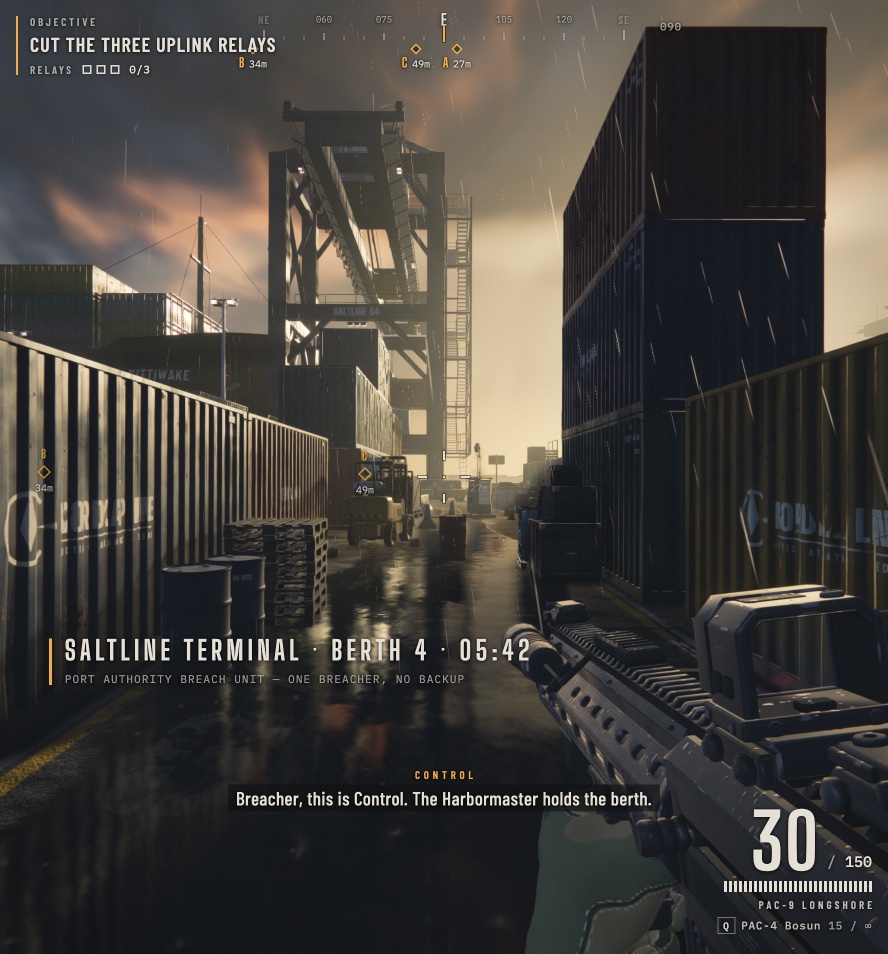
Saltline is a first-person shooter shared by Felix Rieseberg as a Claude Fable 5.2 experiment. Its rainy container port has an immediately understandable mission: cut three uplink relays, then reach a boat. It also makes a useful companion to our earlier BAZAAR ZERO, an urban survival FPS built around escalating enemy waves.
The connection is a design question: how much playable structure can fit inside one compact browser arena? Saltline gives the player places to reach. BAZAAR ZERO gives the player another wave to survive. Below, actual game images help explain the difference and offer a practical starting point for your own project.
Image credit: Saltline / Felix Rieseberg · 2026-11-12
Saltline has an original build and a revised build
In his November 9 release post (UTC), Rieseberg reported about eight hours of generation, approximately $550 at API pricing, 445 million input tokens with heavy caching, and 2.7 million output tokens. He attributed the models, sounds and textures to the model. These are the creator’s reported figures, rather than an invoice we audited.
The distinction that matters when looking at screenshots is inside the game itself. The currently linked Saltline includes a note saying Rieseberg spent another two hours improving weapon models, sounds and some gameplay. It links a separate original one-shot version. We opened both. The current menu offers Mission, Holdout and three difficulty choices; the original menu is a separate artifact.
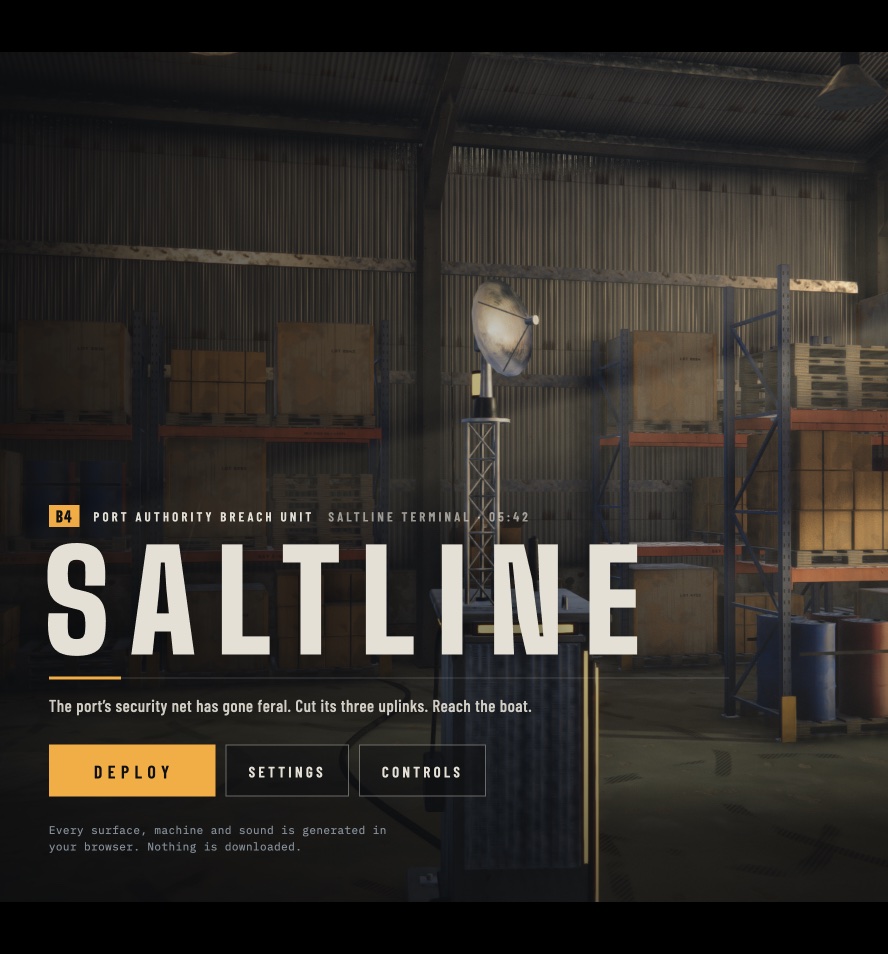
Image credit: Saltline / Felix Rieseberg · 2026-11-12
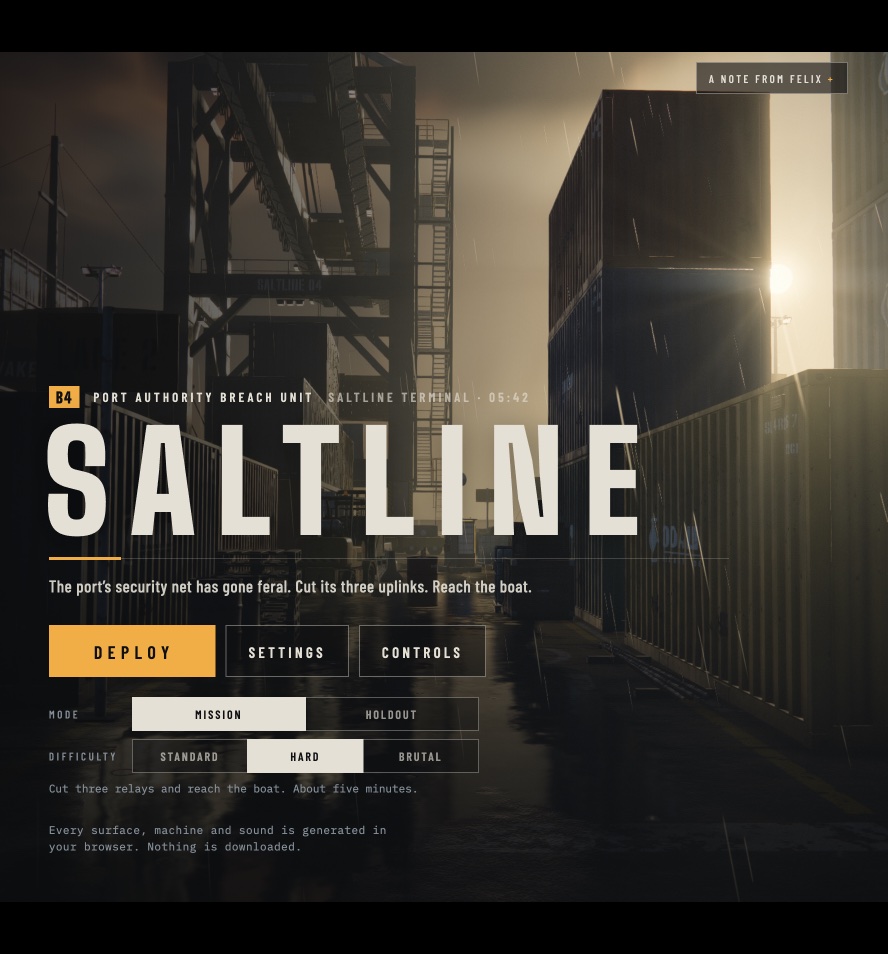
Image credit: Saltline / Felix Rieseberg · 2026-11-12
That makes the revised game a useful example of iteration as well as generation. Keep the initial run’s reported time and cost attached to that initial run. The present screenshots show the revised build unless their caption explicitly says original.
Saltline turns a small port into a mission
The cranes, stacked containers, warehouse shelving, rain and reflective ground establish the location. The objective panel and A/B/C markers give that location a purpose. A player can look from the current weapon and ammunition display to a destination marker and decide where to move next.
For a first visit, use this short route:
- Choose Mission and a difficulty. Standard is a reasonable learning choice. Holdout is also listed, but this walkthrough follows the relay mission.
- Learn the controls before leaving the opening area. The current panel lists WASD movement, mouse look, left-button fire, right-button aim, R reload, Q or 1/2 weapon selection, and holding E to cut a relay. Space jumps, Shift sprints and C or Ctrl crouches.
- Follow the marked objective, then read its interaction prompt. The stated mission is all three relays followed by the boat. Our inspection reached the active mission and pause screen; it does not establish a completed extraction or an optimal route.
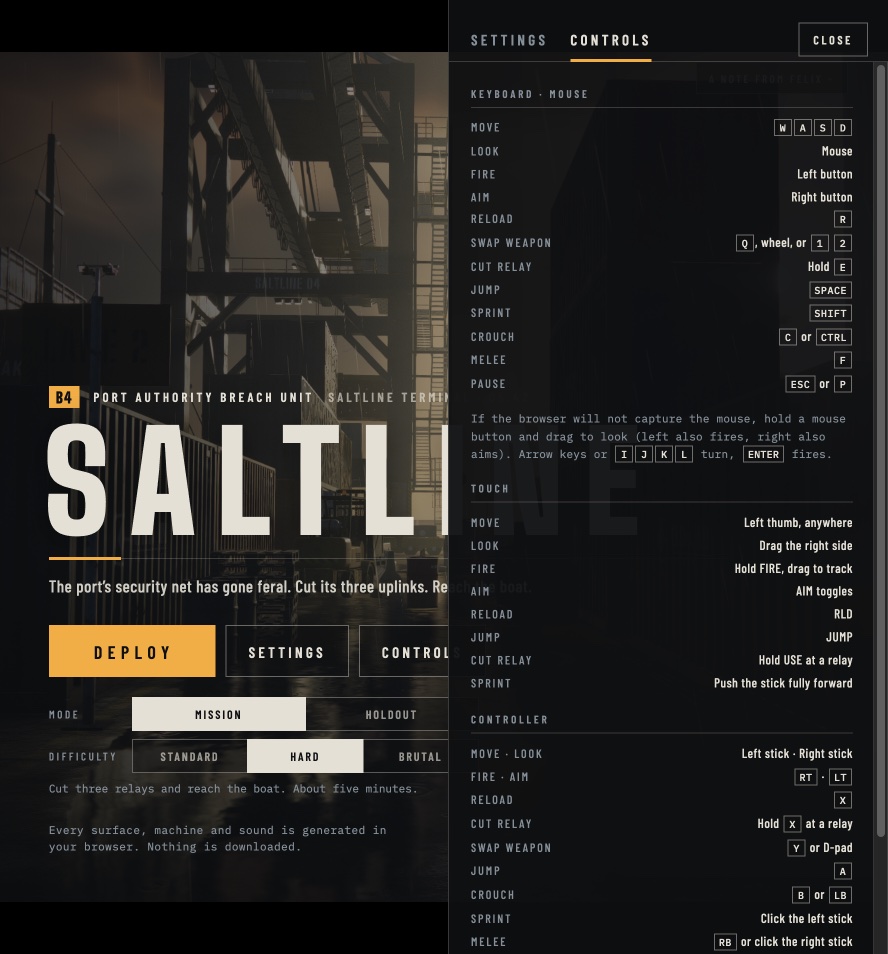
Image credit: Saltline / Felix Rieseberg · 2026-11-12
The control panel is also a useful browser-design detail. It documents alternatives when mouse capture is unavailable, including arrow keys or IJKL for turning and Enter for firing. It lists touch and controller controls too. Our check used a desktop browser; those published input options should not be read as a physical-phone or gamepad test.
BAZAAR ZERO turns one street into repeated pressure
BAZAAR ZERO is our existing hand-finished reference build. Its earlier design article explains the control, wave, score, death and redeployment loop. It is a useful place to continue after seeing Saltline’s objective-driven level.
The live game’s opening panel states the desktop controls and asks for a click to deploy. Movement and mouse aiming serve a different goal here: holding an urban market against successive groups of enemies. The street, stalls and wooden cover break up sight lines, so positioning remains important even within a compact space.
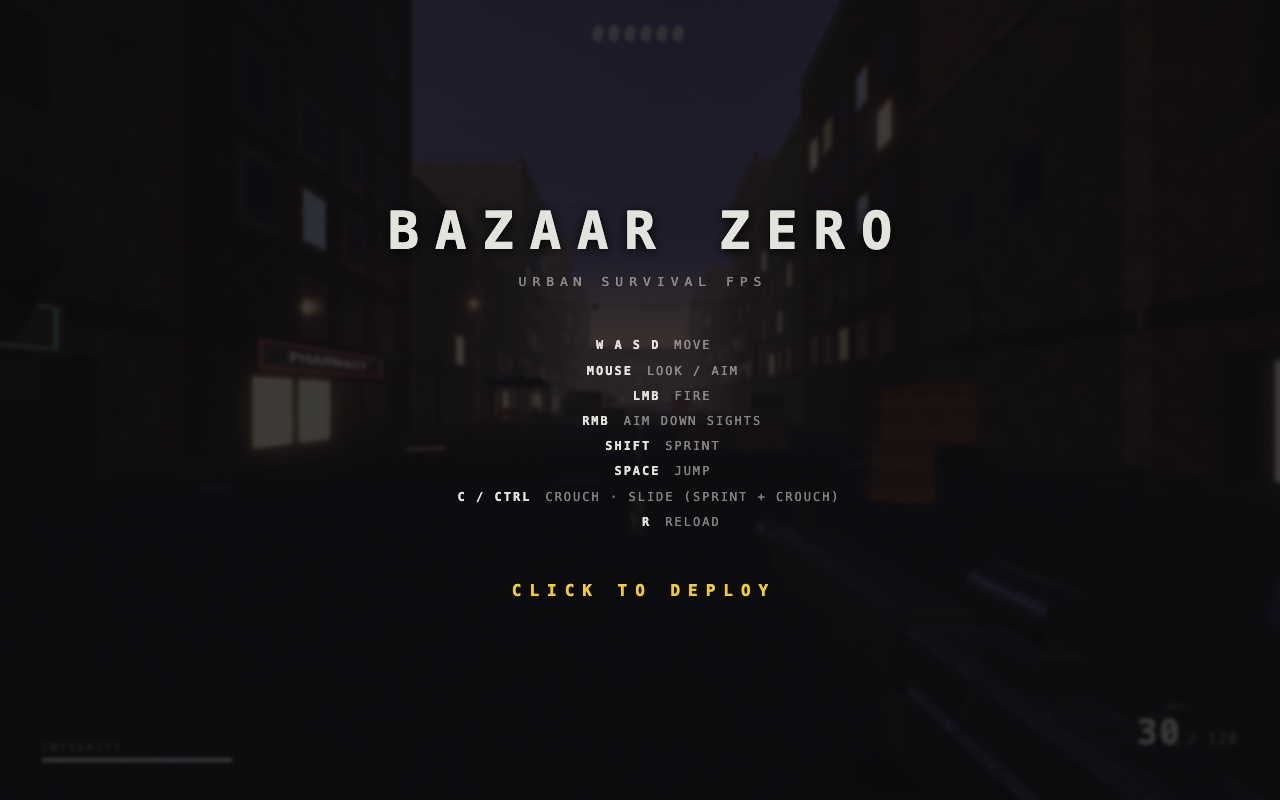
Image credit: BAZAAR ZERO / OpenGame · 2026-11-12
The published build’s wave logic begins with four enemies, adds one per cleared wave up to nine, and leaves a three-second break between waves. A regular elimination scores 100, a headshot elimination 150, and clearing a wave adds 250. We checked those values against the existing first-party build. The images below are captures of its automatic preview mode, rather than a new manual combat run or a human high score.
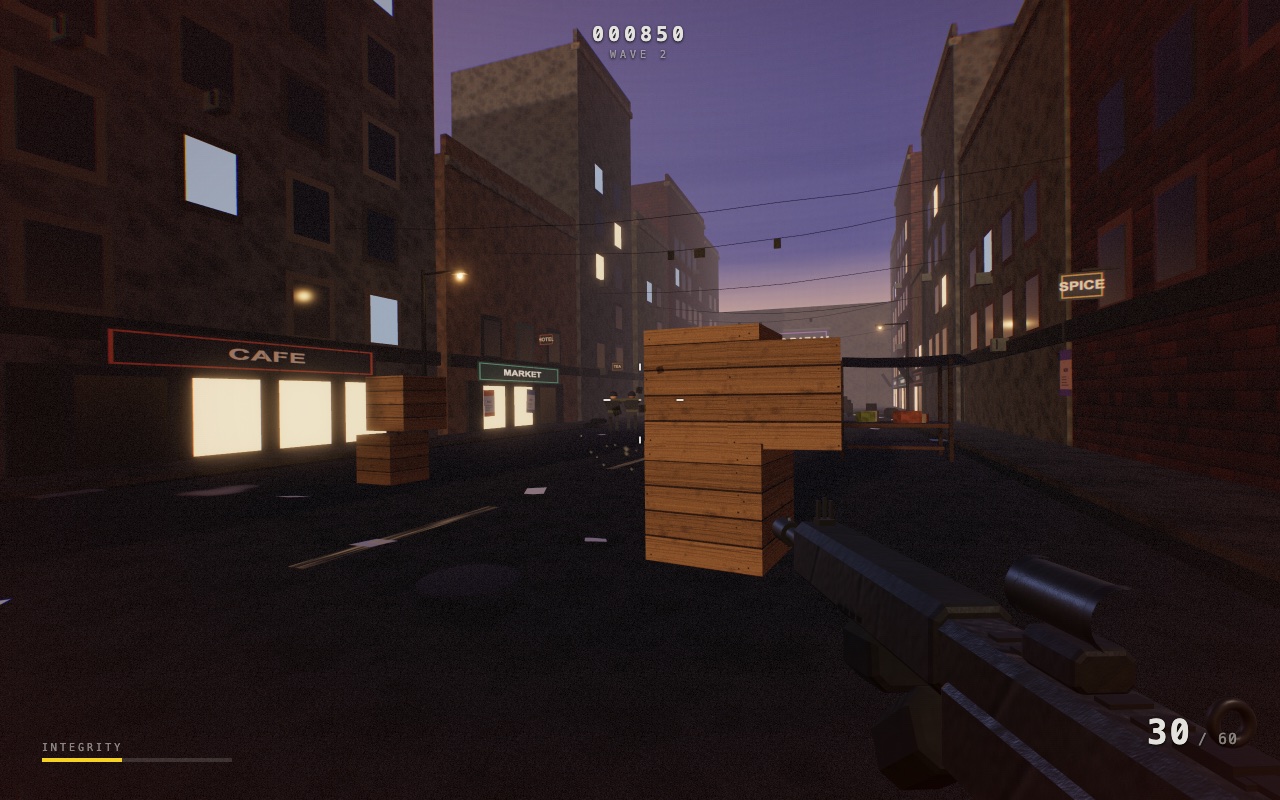
Image credit: BAZAAR ZERO / OpenGame · 2026-11-12
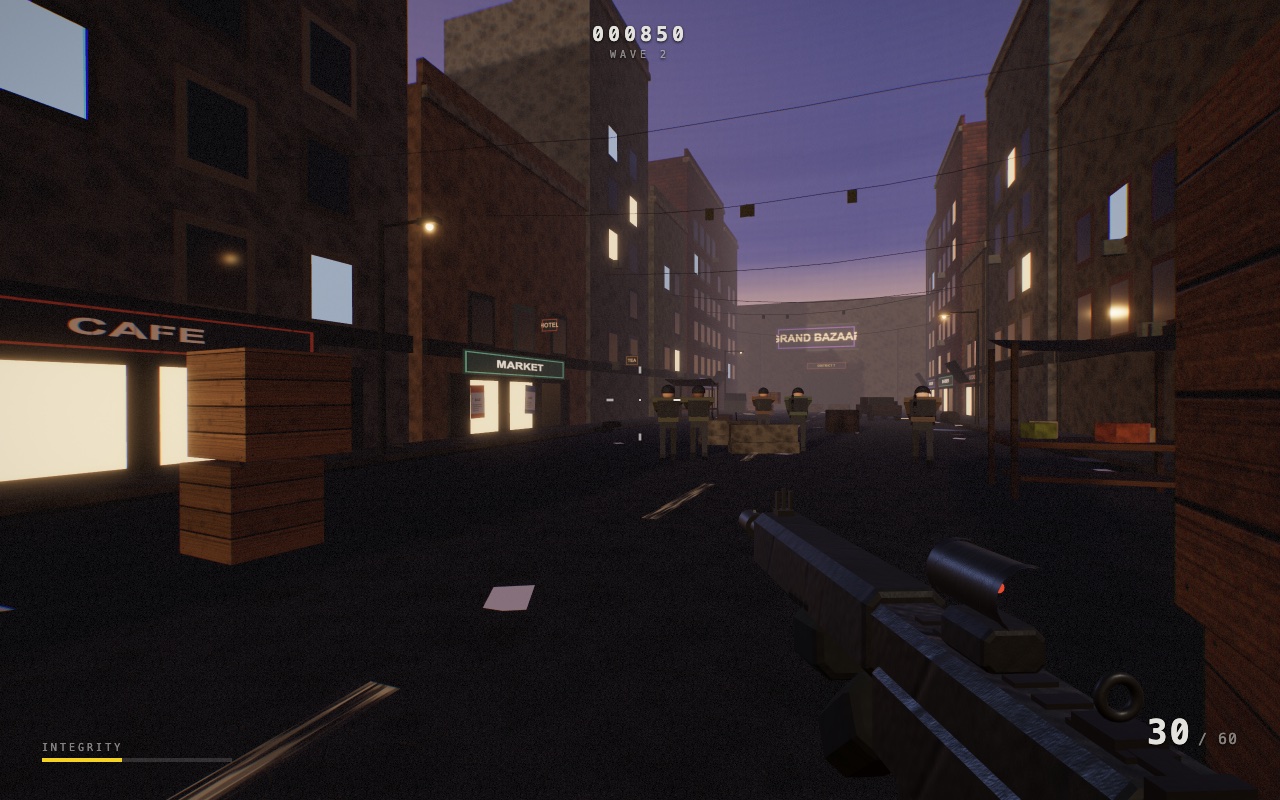
Image credit: BAZAAR ZERO / OpenGame · 2026-11-12
Saltline and BAZAAR ZERO answer different questions
| Design question | Saltline, revised Mission | BAZAAR ZERO |
|---|---|---|
| What moves the run forward? | Three relay targets, then the boat | Clearing successive enemy waves |
| What makes the arena readable? | Port landmarks, objective markers and distances | A long market street, cover and approaching groups |
| What should the player watch? | Relay progress, ammunition, health and the next destination | Ammunition, integrity, wave number and score |
| What makes another attempt useful? | Practising movement and the mission route | Reaching a later wave or improving the score |
| What is the production context? | A reported generation experiment with a separately linked revision | Our earlier hand-finished public reference build |
The practical lesson is to choose a source of pressure before adding more scenery. In a mission, movement changes the player’s distance from completion. In a wave arena, time and the remaining enemies shape the next decision. The same weapon controls can support very different games once the objective changes.
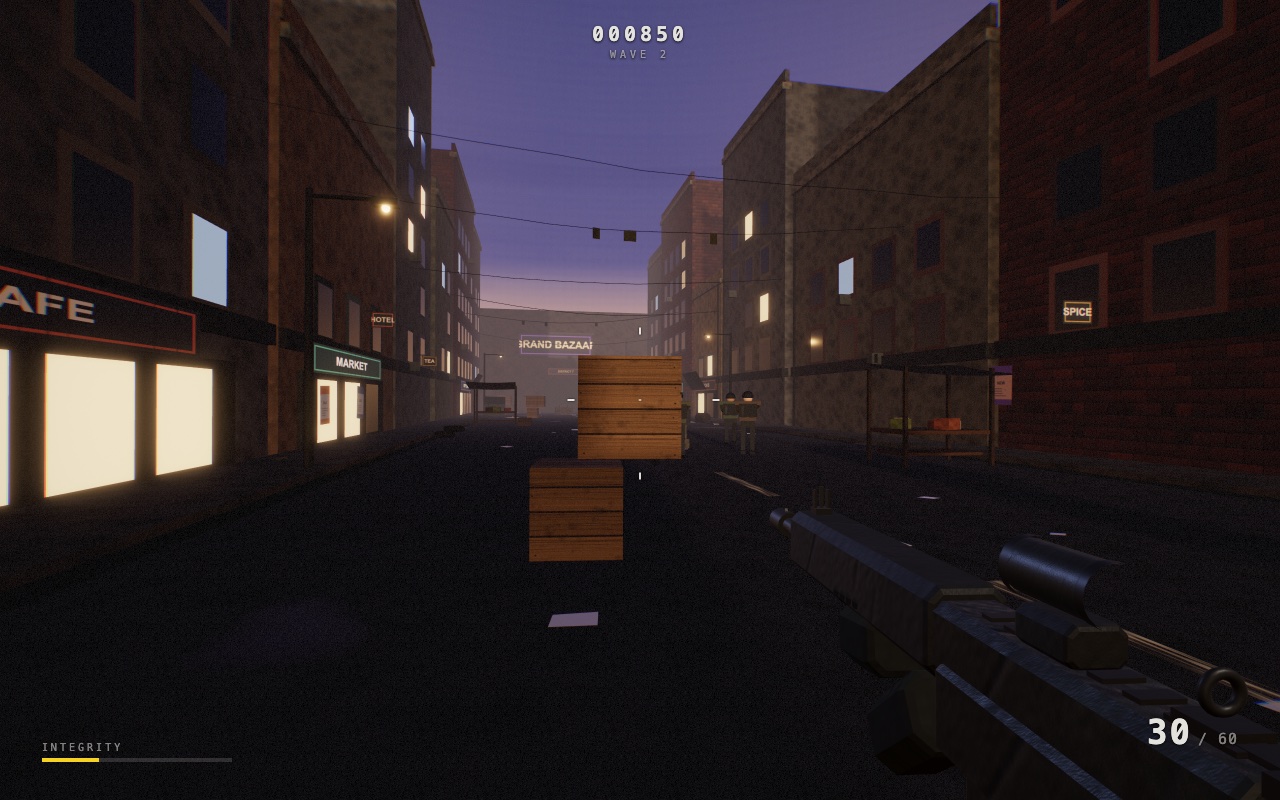
Image credit: BAZAAR ZERO / OpenGame · 2026-11-12
Three ideas to borrow for an original browser FPS
Give the opening screen a job. Explain the goal, controls and the action that starts play. A beautiful scene becomes more useful when the player understands what to do in it. Saltline’s destination markers and BAZAAR ZERO’s wave information make different kinds of progress visible.
Make combat explain itself. Keep ammunition, damage, hit feedback and progress readable while the player is moving. Study how a container lane or a market stall interrupts a line of sight. Then build an original layout with its own rhythm instead of copying either map.
Make returning to play clear. Saltline’s pause interface exposes resume and mission restart. BAZAAR ZERO’s shipped interface provides a final score, reached wave and Redeploy after death. Those are useful specification items before asking an AI to add extra enemies, visual effects or more weapons.
For a next project, a brief could specify a compact maintenance deck, one weapon, one clear objective, visible ammunition and health, an explicit pause, and a complete retry. Decide whether success means escaping after a task or surviving a sequence. Use OpenGame Studio to develop that original specification, and browse more games for other loop structures.
Questions about Saltline and this comparison
Is the current Saltline the unedited one-shot result?
The current artifact contains the creator’s revision note and links the original separately. Check which link you open when discussing the experiment or comparing images.
Is BAZAAR ZERO connected to Saltline’s development?
This article connects two independent browser FPS projects through their design decisions. BAZAAR ZERO is the earlier OpenGame reference. Its generation history and costs are not a matched comparison with Rieseberg’s reported experiment.
Where should I start playing?
Open the author’s current Saltline artifact or the BAZAAR ZERO game page on a desktop with a keyboard and mouse. Read the visible controls, click to focus the game, and use the documented pause or mouse-release action before leaving it. Saltline’s revised controls include alternatives if capture fails; BAZAAR ZERO’s normal play flow requires pointer-lock aiming.
Source note
Checked on November 12, 2026. The source set is Rieseberg’s release post, the current artifact and its creator note, the original artifact, Anthropic’s model announcement, and our published BAZAAR ZERO page, design notes and first-party build.
Saltline images are browser captures of the identified artifacts. BAZAAR ZERO images show its published menu and automatic preview. They retain the game UI and have been resized or JPEG-compressed for this illustrated comparison. Game artwork belongs to its respective creators; this article does not redistribute either game’s code. Mission completion, a fresh manual BAZAAR ZERO combat result, physical mobile play and a controlled performance or model-cost benchmark are outside this inspection.